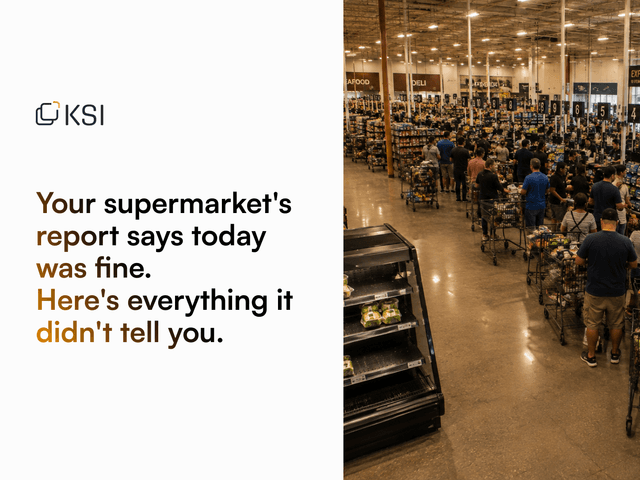
What is the sales conversion rate in retail?
One of the most important KPIs in retail - and one of the most underused. Here is what it is, why it matters, and how to improve it.
What is the conversion rate?
The conversion rate has become a widely adopted KPI in retail because it answers a simple question: what percentage of people who visit my stores actually make a purchase?
Imagine you have a store and observe that 25 people come in during the day, but none of them makes a purchase. In that case, the conversion rate is 0% - a cause for concern. A typical expectation would be that at least 3 or 4 of those 25 people buy something, which equals around 16%. That is what we call the conversion rate.
Mathematically, the conversion rate is calculated as the number of buyers divided by the number of visitors:
Conversion rate = Transactions / Visitors
Standard retail conversion rate formula
Some retailers prefer to compare the percentage change in sales year over year. Others find it more useful to measure traffic and conversion to benchmark against their current sales potential. Both approaches are valid - the key is measuring consistently.
There is no universal percentage that applies to every business. Each retailer is different. But knowing, measuring, and understanding this metric is essential for making informed decisions.
Why is it important to measure conversion rate?
Retail companies often implement traffic counting solutions because of their measurable ROI. When you measure both traffic and conversion, you can set specific KPIs that translate directly into revenue growth:
Traffic × Conversion rate × Avg. ticket = Revenue
Increase any of these variables and your revenue grows
Conversion rate also lets you understand your store's sales potential relative to its actual traffic.
There is a well-documented inverse relationship between traffic and conversion: when traffic is high, conversion tends to be lower. The main driver of this relationship is the level of customer service available in the store. When more people arrive than staff can attend, some leave without buying.
How to improve conversion rate
The goal is to minimize the negative relationship between traffic and conversion. The first step is to study - qualitatively and quantitatively - which factors are degrading your conversion.
A common qualitative example: estimating how much conversion drops due to queues. If a customer sees a long line, they are more likely to abandon the purchase. Measuring this quantitatively - tracking how conversion falls when queues form - gives you a concrete target to optimize.
Staff scheduling based on traffic patterns
Analyze traffic patterns across different hours and days. Schedule staff shifts to match peak periods - maximizing employee-customer interaction opportunities and facilitating purchases.
Staff training
Well-trained employees can answer customer questions, offer product advice, and handle objections. This is one of the highest-leverage levers for conversion improvement.
Store design and layout
An intuitive layout helps customers find what they are looking for - or discover new products they were not expecting. Friction in navigation reduces conversion.
Effective marketing and promotions
Well-communicated offers attract visitors with purchase intent. The higher the intent on entry, the easier the conversion.
Measure, experiment, adjust
Test different strategies, measure the results, and iterate. Without measurement there is no improvement - and without benchmarks there is no way to know what works.
Conversion rate is an indispensable metric in retail for evaluating and improving store effectiveness. There is no 'perfect conversion rate' - the goal is to understand your own metrics and work to improve them continuously.
Measure your conversion rate with cameras you already have
KSI Vision turns security cameras into real-time traffic and conversion metrics.
Request my demoRelated articles
The Operating Leverage Case for Fashion Retail: Why 1% More Conversion Delivers Far More Than 1% More Profit
Corner Conversion Rate: A Better Way to Measure Department Store Performance