
What is the future of video analytics for retail?
To understand the future of computer vision in retail, you first need to understand how AI video analytics was born.
Chapter 1: The beginning - a competition called ImageNet
To understand the future of computer vision, you need to go back to its origin: the ImageNet competition.
ImageNet was an image classification challenge that began in 2010. Researchers competed to build algorithms capable of identifying and classifying objects across 14 million images in more than 20,000 categories. At that point, computer vision was still far from matching human ability.
But one breakthrough changed everything. In 2012, a team led by Alex Krizhevsky - alongside Geoffrey Hinton and Ilya Sutskever (future co-founder of OpenAI) - revolutionized computer vision by presenting AlexNet. It won the ImageNet competition by a wide margin and marked the beginning of the deep neural network era in computer vision.
From that point, AI developed at a dizzying pace. By 2015, AI already surpassed human performance in ImageNet.


Chapter 2: The development - how did computer vision AI evolve in its first 10 years?
After 2012, computer vision went through multiple revolutions and became an essential component in countless applications and sectors. From facial recognition systems to AI-assisted medical diagnosis, and from autonomous driving to industrial inspection, computer vision AI transformed how machines understand and process visual information.
Each year brought new architectures, new training techniques, and new applications - building on the foundation that ImageNet competitions had established.

Chapter 3: Transformers - a second revolution within AI
In 2017, Google researchers once again revolutionized artificial intelligence, marking a turning point for computer vision: the arrival of Transformers.
Transformers, originally designed to process natural language, proved highly versatile and effective at processing visual data. This allowed their natural language understanding capabilities to be transferred to image understanding - creating visual reasoning AI: systems similar to ChatGPT, but applied to images.
Transformers began replacing convolutional and recurrent neural networks (CNN and RNN) in many contexts - the most popular deep learning architectures up to that point.
From November 2022, with the milestone of ChatGPT, machines became fundamentally smarter. Computer vision then fused with natural language processing in multimodal applications - enabling AI that can understand and describe the world in its full complexity.
Zero-shot multimodal AI models allow new intelligence and contextual understanding to be layered on top of existing camera infrastructure - enabling testing and deployment with great flexibility and speed.
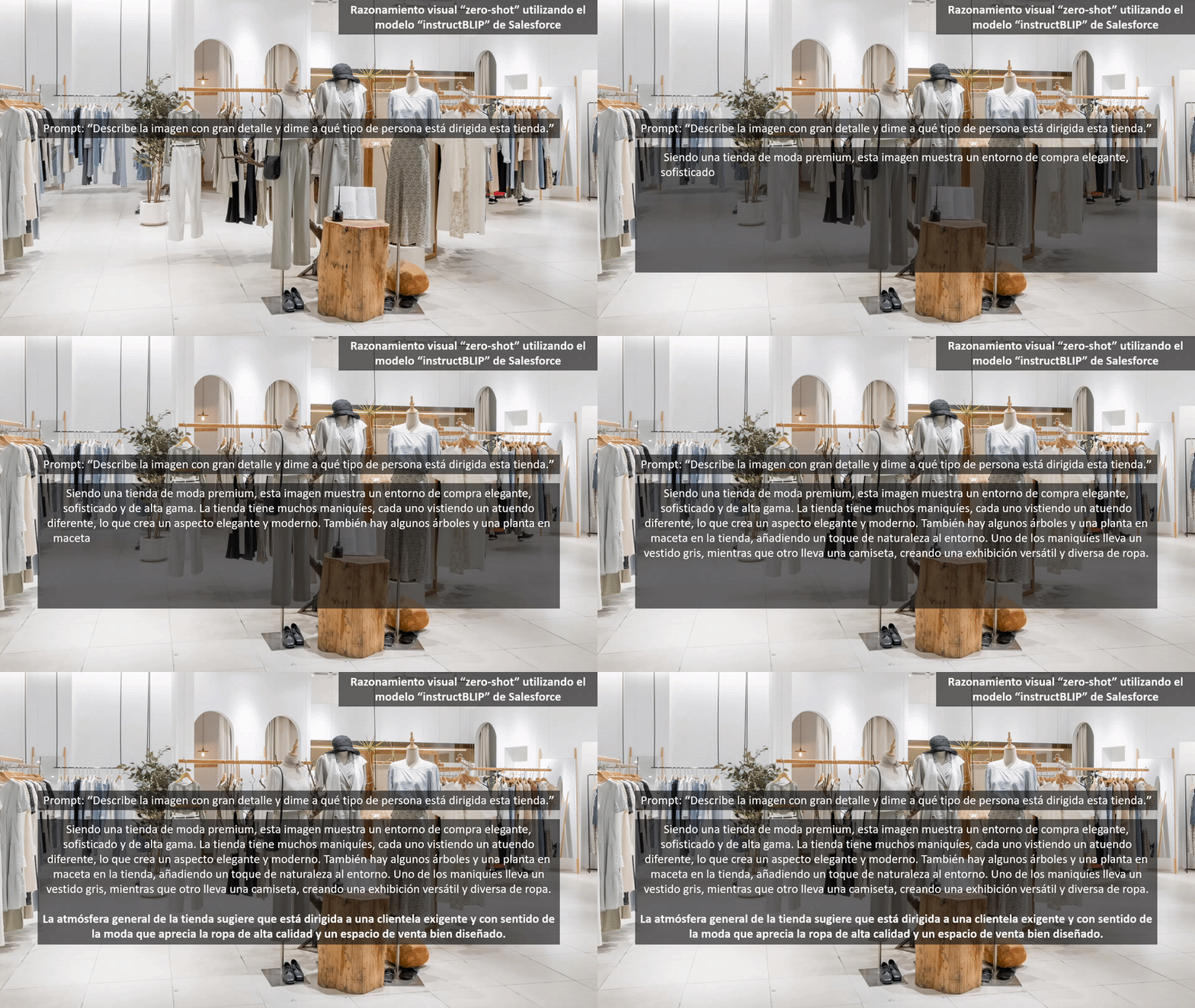
- Flexible functionality - AI is general-purpose and does not require task-specific training
- Rapid feature creation - no specific training cycles needed for new capabilities
- Complex data analysis and insight extraction - high analytical capacity across varied contexts
Now that you know the history of computer vision AI - what is the future of video analytics for retail?
Chapter 5: The future of video analytics in retail
The future of computer vision applications in retail is promising and constantly evolving. The combination of advances in computer vision, AI, and natural language processing has opened a world of possibilities for the retail industry.
Multimodal development enables the creation of AI agents - 'virtual store managers' - highly sophisticated AI entities that can manage and make decisions across multiple dimensions of the business:
People counting, customer capture, and sales conversion
The AI agent evaluates how efficiently the store captures and converts customers into sales - then takes action to detect and resolve inefficiencies.
Queue and customer flow management
Computer vision AI tracks customer flow in the store, identifies congested areas, and helps retailers manage staff and resources more efficiently during peak demand - preventing customers from leaving without purchasing.
Operational task management
Virtual agents can understand complex situations and contexts, enabling efficient management of cleaning, checkout opening and closing, product restocking, and other common retail operations.
Store analytics and decision-making
The AI agent collects data on customer traffic, product layout, and the effectiveness of promotions - then suggests decisions to improve product distribution and customer experience.
Personalized shopping experiences
Computer vision systems can identify clothing a customer is looking at and suggest outfit combinations or accessories - improving the shopping experience and increasing sales.
Inventory management
AI agents continuously monitor stock levels in stores and automatically alert when products need replenishment - helping prevent lost sales from stockouts.
Targeted advertising and audience analysis
Virtual AI managers can identify customer demographics - age, gender, and other characteristics - to adapt advertising in real time, ensuring promotions and products are more relevant to the target audience.
Customer behavior analysis
Computer vision can track and analyze customer behavior in the store - which products they look at most frequently, how long they spend in certain areas - providing valuable data for marketing and store design decisions.
Window display and product layout optimization
AI agents can evaluate the effectiveness of window displays and product placement, enabling retailers to adjust their visualization strategy to attract more customers.
Virtual AI agents - 'virtual store managers' - are systems that will generate tangible benefits for retail through highly automated activities. By leveraging computer vision and artificial intelligence to make real-time data-driven decisions, they will optimize store management, improve customer experience, and increase operational efficiency - ultimately leading to higher sales and customer satisfaction.
See how KSI Vision can help your business
Real-time analytics from cameras you already have.
Request my demo

