
The Race for Context: How to Measure What Happens Across Hundreds of Thousands of m²
AI agents already analyze sales and traffic. What they lack is context: what happens inside the space. The way that context is captured will separate the leading operators from the rest.
Large physical spaces have entered a new phase. Shopping centers, airports and retail chains already use AI assistants to read sales, traffic and occupancy. Those assistants can say how much an indicator dropped. They cannot say why.
The reason is simple: the AI does not see what happens inside the space. It sees the doors and the cash registers, but not the floors, the corridors, the escalators or the store fronts. The value of AI in physical spaces no longer depends on the model. It depends on the context the model receives.
That is the race for context. And it is being decided by an architectural choice that most operators made years ago without knowing it would matter this much.
More AI is not needed. More context is.
E-commerce has twenty years of context: every click, every search and every abandoned cart is recorded. That is why an AI assistant can explain a drop in online sales. In physical spaces, the data usually stops at the edges: counts at the doors and sales at the registers. The same happens in a shopping center, a retail chain or an airport.
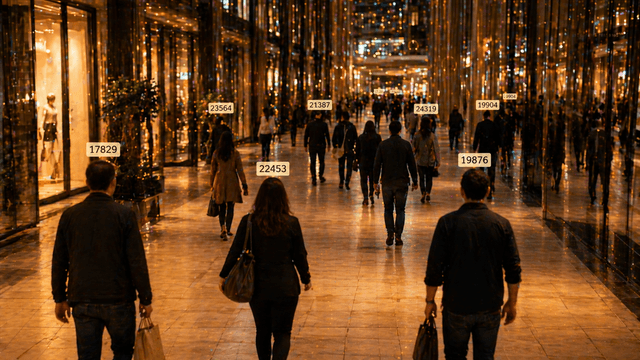
Capturing context at scale means measuring what happens inside, continuously and anonymously: flows between floors and zones in a 100,000 m² shopping center, visits and queues in hundreds of stores at once, journeys and waiting times in an airport terminal. The question is not whether that is useful. The question is which architecture can do it at a reasonable cost, and keep doing it as AI evolves.
AI already knows how much. It does not know why. Context is what turns an indicator into an explanation.
Same question, same AI: the difference is what it can see
A real example from a shopping center in South America. The total traffic of the center held steady, but one floor started receiving fewer visits. The question to an AI assistant was the same in both cases: why does Level 2 receive fewer visits if total traffic held steady?
Entrance counts only
"It is not possible to know what changed."
With KSI connected via MCP
People going up to Level 2 by escalator, per 100 visitors, per week
Two escalators were reversed on 28/9. Since then, fewer people go up to Level 2.
With entrance counts only, the assistant can only confirm that traffic held steady. With the camera data connected via MCP (the open standard that connects AI assistants to data sources), it sees the flow between floors week by week: after two escalators were reversed, 8.2% fewer people went up to Level 2. The answer arrives with the cause and the moment it started.
How the industry changed: from vertical to agentic
For years, analytics in physical spaces was bought as a closed package. The same vendor manufactured the equipment, installed it, built the network, developed the software and integrated it with the client. Changing one piece meant changing the vendor, and what could be measured depended on the device purchased.
Then the chain split into layers: camera manufacturers, installers, network and IT providers, AI software and integrators. The operator could choose the best option in each layer. KSI was born in that shift: AI software on cameras of any brand, without manufacturing or installing hardware.
Today AI agents are disrupting several of those layers at once. Hardware becomes a commodity: a camera only needs to record well. Dashboards and reports are absorbed by agents. Integration is standardized through MCP. And a new layer appears: analysis and action, where agents explain, recommend and alert.
One vendor controls the chain
Hardware, installation, network, software and integration in a single closed package.
A specialist per layer
The operator chooses the best option in each layer. KSI is born here, as AI software.
Agents disrupt several layers
Perception gains value; dashboards, integration and analysis move to agents.
Three types of operators
In this transition, large operators are splitting into three groups. The difference is not budget or intent. It is where each one decided the AI should run: in a dedicated sensor, inside each camera, or as software on the cameras that already exist.
Counting sensors
Dedicated devices at the entrances.
Counts how many people come in. Does not see the inside.
LimitedSmart cameras
AI built into each new camera.
Expensive per point, obsolete in about 5 years, vendor lock-in.
Does not scaleAI as software
Perception layer over the existing cameras, connected to agents.
Full coverage, evolving AI, several vendors competing.
ScalesThose who stay with the old model
Dedicated counting sensors at the entrances, with or without AI. They solved the question of the last decade: how many people came in. Their limit is structural: high cost per analytics point, a second fleet of devices to maintain next to the CCTV, vendor lock-in and innovation that arrives only when the manufacturer renews its product line.
Those who fall into the embedded-AI trap
Replacing sensors with smart cameras looks like modernization. In practice it repeats the same model with a more expensive device: a camera with embedded AI can cost up to USD 1,000, becomes obsolete in about 5 years and ties the analysis to the hardware vendor again. At that price per point, covering a 50,000 m² shopping center, an airport terminal or a network of hundreds of stores becomes unviable, and the AI stays frozen at the version that came with the device.
What the leading operators are doing
The most advanced operators separate the infrastructure from the intelligence. Cameras of any brand, owned by the operator, that only record. A perception layer, delivered as software, that turns video into anonymous and auditable data. And agents connected through an open standard that query that data in natural language. Each layer can be replaced without rebuilding the rest.
Why only one architecture survives at scale
Seen from first principles, measuring what happens inside an entire space, or an entire network of spaces, is a decision tree. Each wrong decision makes full coverage economically unviable.
Dedicated sensors, with or without AI
- High cost per analytics point
- Duplicated maintenance next to the CCTV
- Vendor lock-in
- Innovation in the vendor's hands
AI embedded in new cameras
- Up to USD 1,000 per camera
- Unviable for large spaces or networks
- Obsolete in about 5 years
- Vendor lock-in
AI as software on the existing cameras
Cameras from USD 50- Vendor competition
- Several AIs in parallel
- Evolving AI
- Agentic connection via MCP
- Cost per analytics point
- Coverage of the whole space
The only branch that reaches the goal is AI as software on the existing cameras. Where coverage must be extended, cameras are available from USD 50. In real projects, KSI has validated a difference of 10x or more compared with dedicated hardware: lower infrastructure cost and more analytics coverage for the same budget.
How it plays out in each vertical
The principle is the same in every vertical, but the unanswered question changes, and so does what each path looks like. Each vertical has its own article with published cases.
Beyond the entrances
Why does a floor lose visits if total traffic holds steady?
more real visitors detected when a group of shopping centers replaced its counting sensors
From one store to the whole network
Why does conversion drop if traffic is the same?
monthly sales recovered per store in a chain of more than 2,000 stores
Every minute in a queue counts
Why does commercial revenue drop if there are more passengers?
sales in commercial spaces after reducing waiting times
How the stack will look: infrastructure, data and agents
In the model that is consolidating, each layer will have a clear owner and the operator will be able to change any of them without rebuilding the others.
The team decides and acts with evidence instead of intuition.
Claude, ChatGPT, Gemini or KSI's agents analyze, alert and propose.
Any agent accesses the data without custom integration projects.
Specialized AI that turns video into anonymous, auditable data.
Cameras of any brand that only record. Intelligence sits on top.
- Vendor competition: perception providers will compete on intelligence over the operator's infrastructure, not on hardware.
- Several AIs in parallel: different models and vendors can run on the same cameras at the same time.
- Evolving AI: improvements will arrive as software updates, without replacing devices.
- Agentic connection: Claude, ChatGPT, Gemini or KSI's own agents will query the data through MCP.
- Cost per analytics point, not per device, and coverage of the whole space.
The operator that owns its infrastructure and chooses its data layer will be able to adopt each new generation of AI on the day it appears.
Frequently asked questions
AI agents can already analyze sales and traffic, but they do not see what happens inside physical spaces. Whoever captures that context at scale, reliably and anonymously, will get explanations and actions from AI instead of just indicators.
Because it repeats the hardware model with a more expensive device: up to USD 1,000 per camera, obsolescence in about 5 years and vendor lock-in. At that cost per point, full coverage of a large space or a network of stores is not viable, and the AI does not evolve after installation.
No. KSI is software that works on the CCTV already installed, of any brand or model. Where an extra viewpoint is needed, standard cameras are available from USD 50.
Through MCP, an open standard that exposes KSI data and tools to agents such as Claude, ChatGPT or Gemini, without custom integrations or duplicating data in another system.
Yes. KSI interprets behavior, not people: no facial recognition, no image storage and compliance with GDPR. The output is anonymous, aggregated flows and times.
See how KSI will measure what happens inside your spaces with the cameras you already have
Related articles
KSI News!